
With the continuous development of modern engineering and construction sectors, the demands for material performance have become increasingly stringent. Glass Fiber Reinforced Polymer (FRP or GRP) is emerging as the “new favorite” in corrosive environments and high-tech fields, offering comprehensive advantages that steel, aluminum, and wood simply cannot match. As a core and critical raw material in glass fiber manufacturing, the stable supply and LSAK exceptional quality of high-grade albite (sodium feldspar) powder are becoming a crucial cornerstone driving this industry upgrade.
FRP Profiles Shine, Glass Fiber Performance is Key
It is well known that FRP profiles are widely recognized as ideal alternatives to traditional materials, thanks to their unique physical and chemical properties. Compared to steel or aluminum systems, glass fiber endows FRP with a higher strength-to-weight ratio, alongside exceptional resistance to fatigue, creep, and permanent deformation. In terms of weight, pultruded glass fiber has a specific gravity of only one-quarter that of steel and two-thirds that of aluminum, which greatly simplifies on-site installation and handling.
Furthermore, the insulation and wave-transmitting characteristics of glass fiber are second to none. It can be safely used in electrical operating areas without requiring special support conditions to prevent electrolytic corrosion. Meanwhile, pultruded glass fiber does not interfere with the transmission of electromagnetic and radio frequency signals, making it safe for use in various signal towers and transmission structures. However, these outstanding end-use performance attributes depend heavily on the quality of the source raw material—glass fiber.
Precise Control of Chemical Composition: Creating the “Genes” of High-End Glass Fiber'
“Exceptional glass fiber is inseparable from high-purity, highly stable mineral raw materials,” noted industry experts. As a specialized supplier focusing on albite powder, we deeply understand the decisive impact of raw material formulation on the glass fiber drawing process and its final performance. Therefore, we have launched a premium albite powder tailor-made for the glass fiber industry, empowering downstream enterprises with stringent specification standards.
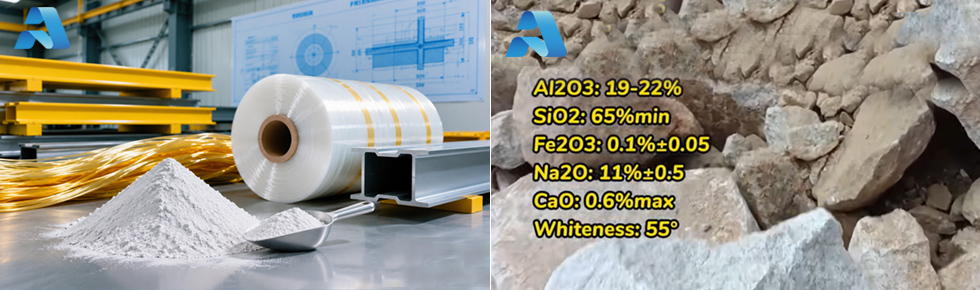
Tailored to the production process requirements of glass fiber, the core chemical composition of our albite powder is precisely controlled:
SiO?: 66% (±1%) — Forms the silica backbone of the glass fiber, ensuring the material’s structural strength and chemical stability;
Al?O?: 20% (±1%) — Significantly enhances the fiber’s heat resistance, mechanical strength, and corrosion resistance;
Na?O: 11% (±0.5%) — Acting as an efficient flux, it effectively lowers the glass melting temperature, improves the clarification and homogenization of the glass melt, and saves energy;
Fe?O?: 0.1% (±0.05%) — Extremely low iron content control ensures the whiteness and light transmittance of the glass fiber, preventing performance degradation caused by iron ions;
CaO: 0.6% (±0.1%) & TiO: 0.03% — Precise balancing of trace elements further optimizes the drawing and forming stability of the fiber.
Customized Particle Size Services to Meet Diverse Pultrusion Process Needs
Beyond the strict control of chemical composition, particle size distribution directly impacts the melting speed and final quality of the glass fiber. Our albite powder covers a particle size range from 100 mesh to 1250 mesh. We also offer flexible, customized particle size services based on customers’ specific pultrusion processes and furnace conditions, ensuring that the powder melts quickly and uniformly in the furnace, reducing dust and stone defects, and increasing the yield of the drawing process.
Looking Ahead: Joining Hands to Create a New Era of Lightweight and Corrosion Resistance
As FRP materials continue to penetrate sectors such as rail transit, marine anti-corrosion, 5G base stations, and electrical insulation, the market demand for high-quality glass fiber will continue to surge. As a solid backing in the upstream of the industry chain, LSAK Feldspar will continue to deepen our expertise in the purification and processing of albite powder. With stable quality and customizable specifications, we aim to provide a continuous supply of “premium genes” for the global FRP industry, jointly promoting advanced composite materials to break traditional material boundaries and empowering the green and efficient development of modern engineering construction.